

LendingHub · Case study
From spreadsheet to investor portal.
Building a hard money lender room to grow.
Multi-tenant investor platform · Built for hard money lenders, with Mako Loans as the first implementation.
Explore the platform Demo data
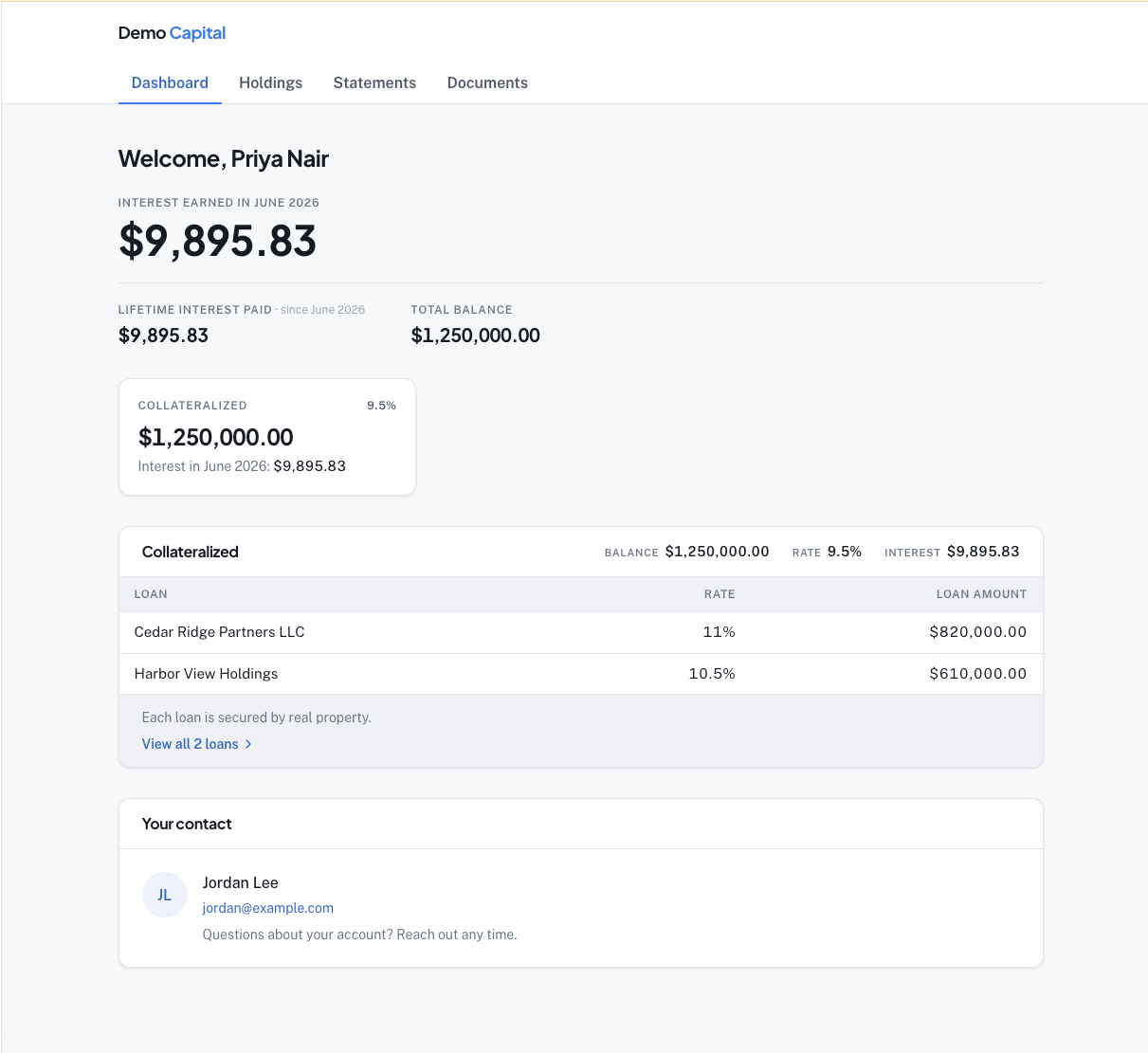 Investor dashboardView full size ↗
What we built. An investor portal built around the accounting: positions across entities, interest calculated on average daily balance, consolidated monthly statements, and per-entity 1099s. The dashboard and documents draw from the same ledger, with a multi-tenant foundation for additional lenders.
- Ledger accounting
- Investor dashboard
- Monthly statements & 1099s
- Multi-entity positions
- White-label tenancy
- Document delivery
Starting point
A capital operation ready for its next stage
A hard money lender serves two distinct groups: borrowers seeking financing and private investors providing capital. LendingHub was built for the investor side of that business.
Mako had developed detailed Excel workbooks around its own capital management processes. Those files captured how the team tracked positions, calculated interest, and assembled statements, drawing on years of lending and operational experience.
The opportunity was to make that knowledge accessible through a shared platform. An investor portal could bring positions, earnings, and documents into one place, while preserving the accounting rules the team had developed.
The workbooks were the starting point for the build. Their structure and business logic informed a system designed to support a growing investor base and consistent reporting.
The ledger
Get the ledger right. Build the portal around it.
- 01Investor positionsAccounts, entities, and activity
- 02One ledgerBalances, interest, and proration
- 03Consistent reportingDashboard, statements, and 1099s
LendingHub was built as a ledger first. The investor portal, statements, and tax reporting all read from that accounting foundation.
The interest calculation uses average daily balance and the account’s rate to determine monthly interest, with consistent rules for cent-level rounding and proration. Funding dates feed into the daily balance calculation so mid-month activity is reflected in the reporting.
The ledger supports the account types Mako uses: collateralized, funding, and participation accounts. Each retains the details needed for its role in the lending business.
The dashboard consolidates positions, earnings, and year-to-date figures across an investor’s entities. Entity-level labels remain available in the detail views, while 1099 reporting stays per entity.
One ledger connects the investor’s dashboard, monthly statements, and entity-level reporting.
Reporting
A shared source for month-end reporting
Monthly statements are generated as a consolidated PDF for each investor from the same ledger that powers the dashboard. Per-entity statements are also available, and 1099s are generated per entity.
The investor view brings balances and earnings together with document access. Lifetime interest tracking begins on January 1, 2026, giving that cumulative figure an explicit starting point.
For QuickBooks Desktop, the accounting handoff uses an import workflow. This gives the back office a defined path for moving the platform’s accounting output into its existing tools.
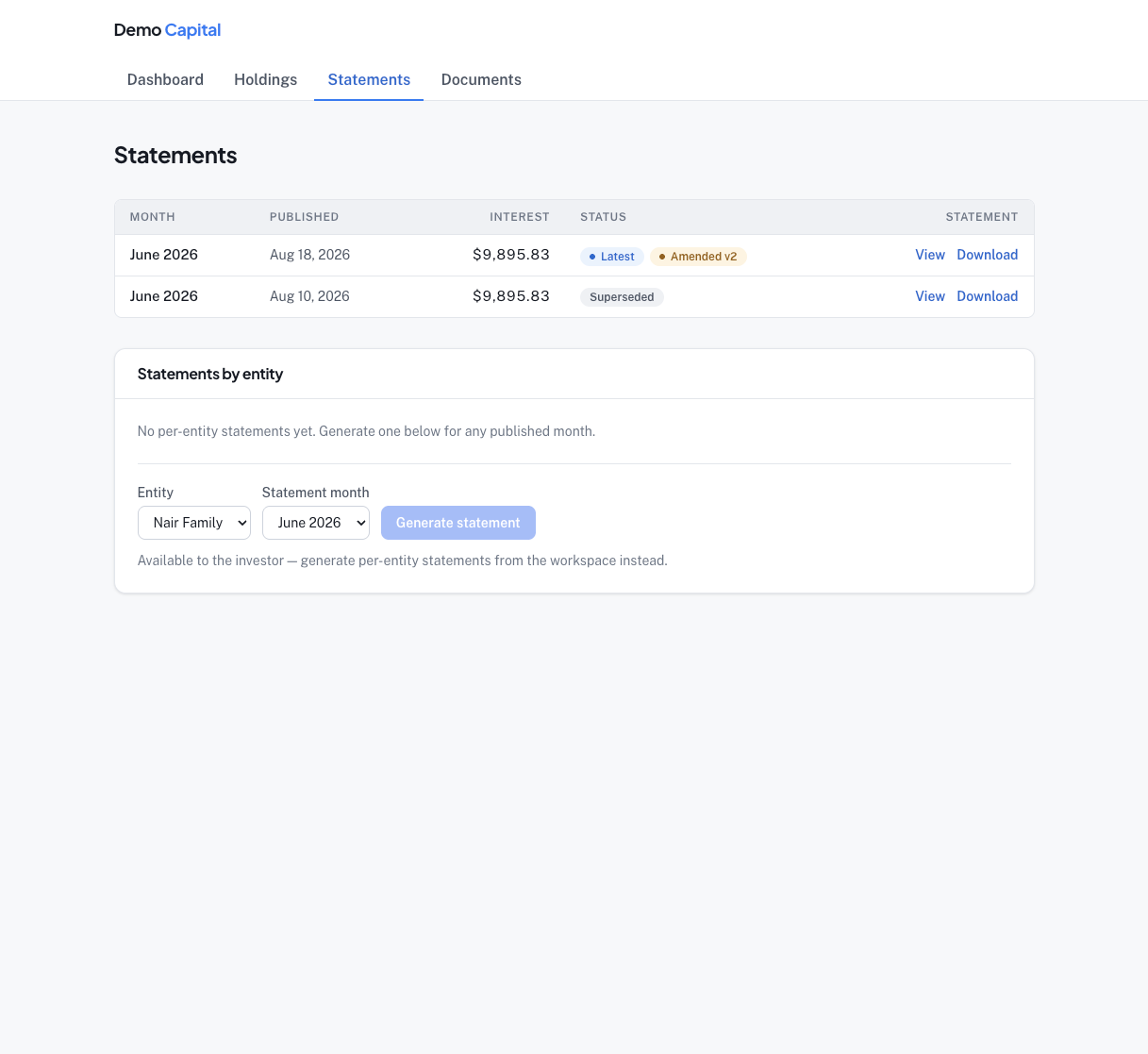 View full-size screenshot ↗
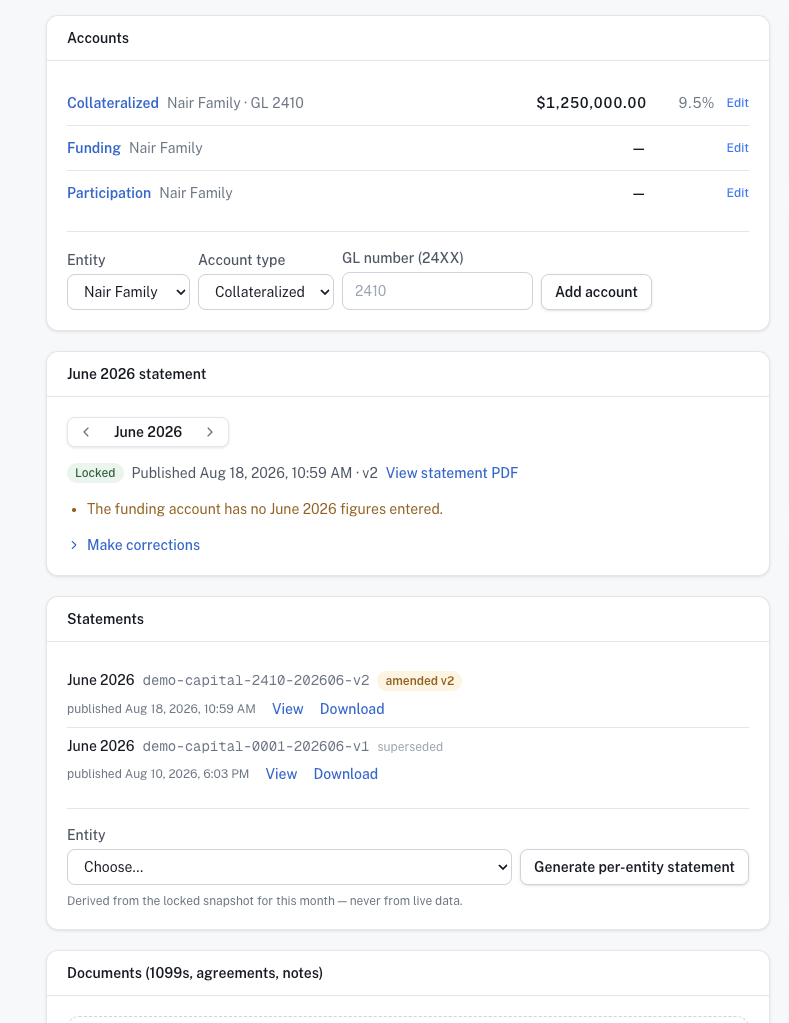 View full-size screenshot ↗
The fit
Why a purpose-built investor portal?
Mako’s requirements centered on continuous funding activity, deal-specific collateral, different account types, and daily balance-based interest. The platform needed to reflect that operating model.
A fund administration platform organized around commitments, capital calls, and waterfall distributions would need to be evaluated against those requirements. For this project, the team’s existing workflows and accounting rules provided the specification for a dedicated system.
The aim was to carry that established knowledge into custom business software with investor access and repeatable document generation.
Built to work together
Inside the platform
Multi-tenant from day one
LendingHub was designed to support multiple lenders. Postgres row-level security enforces tenant boundaries at the database, keeping each lender’s investor records, ledgers, and documents scoped to that lender.
That architecture was part of the initial build, with Mako as the first implementation.
White-labeled to the lender
The investor experience carries the lender’s branding. Login, portal access, and document delivery are designed to feel like part of the existing investor relationship.
 Illustrative workspace
Positions, earnings, and documents under your lender’s brand.
- Investor records
- Ledger & accounts
- Documents
Demo Capital has a separate workspace.
Built from the real workflow
Before designing the schema, we worked through the back office’s existing workbooks. Those files captured institutional knowledge: how proration works, which figures belong on a statement, and what investors need to see. The data model followed that workflow.
Decisions about rounding, amortized deals, and the information shown in consolidated views were documented with Mako before implementation.
The stack
Next.js and TypeScript on Vercel, with Supabase for Postgres, authentication, and document storage, and Resend for transactional email. The stack supports the ledger, lender-specific access, reporting, and document delivery in one platform.
Start with a conversation
Who this investor portal is for
You have a business process supported by carefully maintained spreadsheets, and you want more people to access the information or complete their work without adding more manual steps. For Mako, that process was investor capital. In another business, it might be billing, inventory, commissions, or a workflow that needs to follow rules specific to the operation. We map the existing process, document the decisions that matter, and build software around the knowledge your team already has.
We’ll discuss the fit, scope, and costs before work begins.
Step 1 of 2 · Your business
Where should we start?
Choose a priority to continue.